SANGEET RATNAKAR
Importance and Content of Sangeet Ratnakar Book
Lalita Anand Pandey
3/24/20263 min read
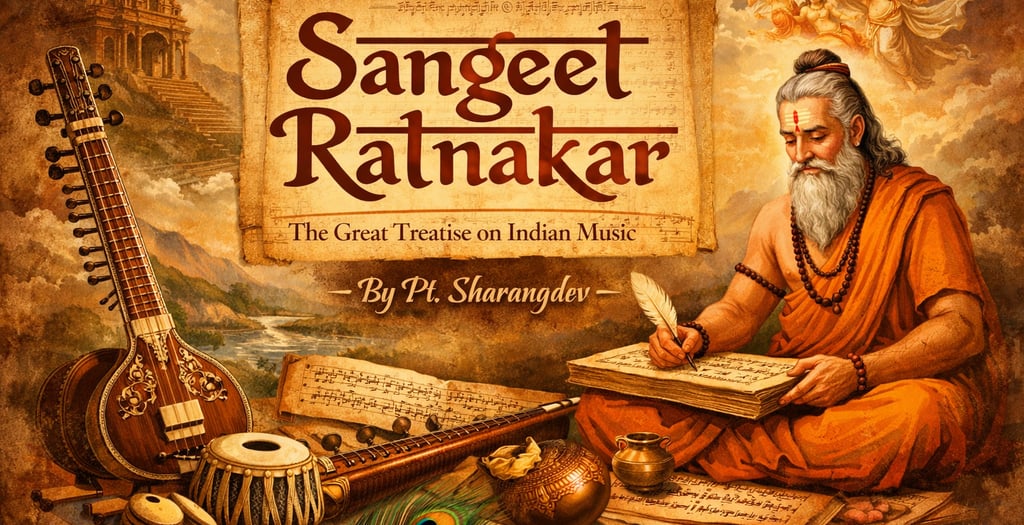
🔹 Sangeet Ratnakar is a famous Sanskrit text on Indian classical music,
written by Pandit Sharngadeva in the 13th century. It is considered a major
treatise that is respected in both Hindustani and Carnatic music traditions.
The book is also known as “Saptadhyayi” because it contains seven
chapters covering various topics like swara (notes), raga, tala (rhythm),
instruments, and dance. It connects ancient knowledge from the Vedic and
post-Vedic periods and explains both theoretical and practical aspects of
music.
Structure of Sangeet Ratnakar (7 Chapters)
📘 1.
Swaradhyay or Swargatadhyaya
– Chapter on Notes
● Discusses Nada, Shruti, Swara, Alankar, Jati, Saptak, etc.
● Differentiates between Shuddha (pure) and Vikrit (altered) notes.
● Talks about Gram, Murchhana, Tan and their significance.
📘 2.
Rag Vivekadhyaya
– Chapter on Ragas
● Defines Raga and its emotional purpose (Rasa).
● Classifies ragas into:
○ Margi Ragas (Classical/formal)
○ Desi Ragas (Folk/regional)
● Mentions 264 ragas.
● Describes Dashvidha Raga Classification (10 types)
📘 3.
Prakirnadhyaya
– Miscellaneous Topics
● Describes creative freedom in music:
○ Ragalapti, Roopkalapti (improvisational styles)
● Discusses:
○ Qualities of a good composer(Vaggeyakara),singer
○ Vocal techniques and faults in singing.
○ 15 types of Gamak.
📘 4.
Prabandhadhyaya
– Chapter on Compositions
● Divides music into:
○ Nibbaddha (structured/composed)
○ Anibbaddha (free/alaap-style)
● Defines Prabandha as a bound, well-structured musical form.
● Describes 4 Dhatu and 6 Ang
📘 5.
Taladhyaya
– Chapter on Rhythm
● Classifies Talas into:
○ Margi Talas (ancient)
○ Desi Talas (folk/regional)
● Mentions 120 Desi Talas and 5 Margi Talas.
● Introduces 10 elements of Tala (Tal-Dash-Pran).
📘 6.
Vadyadhyaya
– Chapter on Instruments
● Divides musical instruments into 4 types:
1. Tat (String)- sitar,tanpura
2. Sushir (Wind)-Flute,shehnai
3. Avanaddha (Percussion)-Tabla,Dholak
4. Ghan (Solid/Metallic)-Manjira,Ghanti(bell)
📘 7.
Nartanadhyaya
● Describes Drama and Dance.
● Describes forms of classical Indian dance before the 13th century.
● Describes Tandava and lasya dance form.
● Tells about 9 Ras(emotions)
Q. Explain the importance of Sangeet Ratnakar.
Ans. Sangeet Ratnakar written by Pt. Sharangdev in the 13th century is one of the most
important texts of Indian classical music. Its importance can be understood as follows:
1. It is accepted in both Hindustani and Carnatic music traditions.
2. Acts as a bridge between ancient (Natya Shastra) and medieval/modern music.
3. Contains 7 chapters, which deal with swaras, ragas, talas, prabandhas, gamakas, and
dance.
4. Describes 264 ragas, 120 talas, and 15 gamakas in detail.
5. Provides a systematic classification of musical concepts.
6. Serves as an encyclopedia of medieval Indian music.
7. Became a base for later texts like Sangeet Parijat and Sangeet Darpan.
8. Very useful for students and scholars as a source of musicology.
👉 Thus, Sangeet Ratnakar is not only a treasure of medieval music knowledge but also a
connecting link that shaped the future of Indian classical music.
Q. How many ragas, talas, and gamakas are mentioned in it?
Ans. It mentions 264 ragas, 120 talas, and 15 gamakas.
Q5. Why is it called the “encyclopedia of medieval Indian music”?
Ans. Because it is a comprehensive text covering theory and practice of music, and served as
the foundation for later treatises like Sangeet Parijat and Sangeet Darpan.
Very Short Answers
Q1. Who wrote Sangeet Ratnakar?
Ans. Pt. Sharangdev.
Q2. In which century was it written?
Ans. 13th century.
Q3. How many chapters are in Sangeet Ratnakar?
Ans. 7 chapters.
Q4. What does Sangeet Ratnakar describe?
Ans. Swaras, ragas, talas, prabandhas, gamakas, and dance.
Q5. How many ragas are mentioned?
Ans. 264 ragas.
Q6. How many talas are mentioned?
Ans. 120 talas.
Q7. How many gamakas are described?
Ans. 15 gamakas.
Q8. Which two music systems accept it as authentic?
Ans. Hindustani and Carnatic music.
Q9. Between which traditions does it act as a bridge?
Ans. Ancient Natya Shastra and medieval/modern music.
Q10. Why is it called an encyclopedia of medieval music?
Ans. Because it gives a complete and systematic description of music.
Q11. Name two later texts influenced by it.
Ans. Sangeet Parijat and Sangeet Darpan.
Q12. What is the overall importance of Sangeet Ratnakar?
Ans. It is a foundation of Indian musicology and a treasure of medieval knowledge.